
Preparing graduates for the world of work
The Department for Science, Innovation and Technology (DSIT) has recently launched a pilot programme to help bridge the gap between university study and industry employment for Data and AI graduates in the UK.
Delivered by the National Innovation Centre for Data (NICD), the AI Traineeship Programme aims to give participants the skills, experience, and confidence to succeed in the country’s growing data and artificial intelligence workforce.
The pilot has two main goals:
-
To develop the industry-relevant skill sets and experience of AI graduates in the UK.
-
To improve the employability of AI BSc and MSc graduates, helping them transition into the AI workforce.
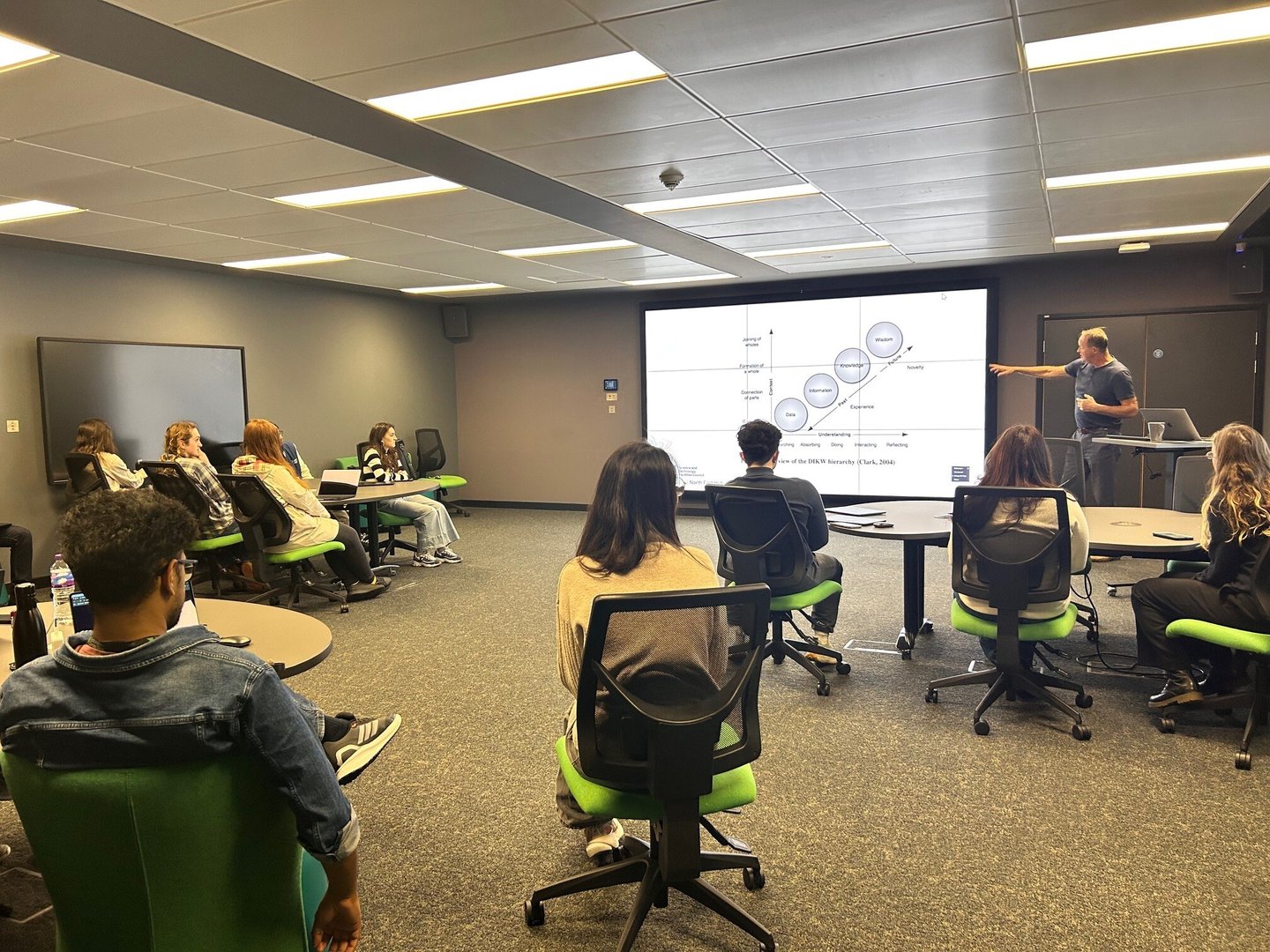
This autumn, NICD welcomed fourteen Newcastle University graduates to the first cohort of the programme, which began with an intensive Data Innovation Bootcamp. The Bootcamp provides an immersive, interactive, and fast-paced programme giving trainees a golden opportunity to work on live business problems alongside industry partners. Trainees collaborated with Ways to Wellness, a Newcastle-based social prescribing organisation, exploring how AI can be used to improve community wellbeing.
AI Traineeship Programme Manager, Angela Craggs, explained:
“The AI Traineeship Programme is designed to empower trainees with the skills and experience needed to thrive in the rapidly growing fields of AI and data science. Through a blend of technical training, mentorship, and real-world industry projects, participants gain both the expertise and practical insight to excel in data-driven careers.”
From classroom to client
Trainees are currently working across a mix of internal research projects and external collaborations with UK Small and Medium sized Enterprises (SMEs), across a range of industries. The current external project collaborators include:
- RevLifter - a marketing technology and services business that supports leading eCommerce brands to increase revenue per website visitor.
- E3 Design - a product and industrial design consultancy working on an AI image processing solution in collaboration with ecologists.
- and Equipmii - an expert-driven platform that assesses how products perform for people with physical impairments—before they hit the market.
One project team recently travelled to Northumberland to understand the environment where their solution will be deployed. Their project focuses on using AI to support red squirrel conservation.
“We went on a field trip and met the stakeholders involved,” said Harish Sai Prasath. “It’s not just a technical exercise. Meeting the people who’ll use our solution makes it feel like the project has life to it.”
Lucy Garden reflected on how the experience differs from university study: “Getting to work on real problems, as opposed to the lab-based work we did at university, has been really fulfilling. It’s satisfying to see how what we’re doing will actually be used.”
Learning Through Doing
For many trainees, the biggest step has been moving from theoretical learning to
practical application.
“Coming from a maths background, I’d never used LangChain or VS Code before,” said Carlo Redpath. “Now I’m using real datasets and learning to clean and manage them properly. It’s a huge change from university projects.”
Ehsan Honarbakhsh agreed: “I’ve learned a lot technically, but also about professional behaviour: how to work with clients, how to communicate my ideas clearly, how to analyse perspectives from a client’s point of view.”
“You get to learn on the job. You’re not just doing the same thing all the time, so you are constantly learning and building on what you’ve done at university,” said Robert Proctor.
The projects also give trainees freedom to explore specialist AI interests. Susi Jahnich, said: “Coming from a maths background, I didn’t really know anything about data science until I came here. I was surprised at the amount of research we’re allowed to do ourselves. We are given the time to become experts in the field of AI we want to pursue.”
Saxen Payne adds, “You’re able to work on AI projects aligned with your interests and what you want to do in the future. We’re paired with mentors who have similar interests, like my mentor who is also in the conservation space.”
Building Confidence and Communication
As well as technical AI skills, the programme is helping trainees develop the professional and collaborative skills that make them employable.
“The first week I was so nervous,” admitted Aoife O’Callaghan. “By the third week I was doing my own presentation and actually enjoying it. My confidence has improved so much.”
Nazli Aldogan, said the experience has changed how she sees herself professionally: “At first, I had a bit of imposter syndrome. But that’s the whole point of this programme - we’re here to learn. It’s okay to not know every technical thing, so long as you’re an adaptive person.”
Wesley Smith described a similar experience: “Over time, I’ve gotten more comfortable bringing up ideas and articulating my thoughts to other people.”
Support and Mentorship
Every trainee has a mentor from NICD’s experienced technical team, providing
individual guidance on both projects and career development.
“My mentor helped me identify my career direction,” said Yanfei Ji. “Before joining, I thought we’d just be learning technical skills, but I’ve also had valuable career advice.”
“The technical team are really generous with their time,” added Nicha Wilanan. "They give us the best experience possible.”
Gulbika Aghamuradova said: “The mentoring sessions have been great. They give us feedback on our CVs, and tips for job applications.”
This support has created what many describe as a safe, encouraging place to grow.
“It’s a safe space to make mistakes and learn at your own pace, without being
judged,” said Susi Jahnich.
Looking Ahead
The trainees will begin new client collaborations in the new year as the programme moves into its second phase. For many, the experience has already been transformative.
Lucy Garden, says “I’ve been learning technical skills outside of my comfort zone, so I’m looking forward to seeing how the next projects will help me upskill even further.”
Susi Jahnich, adds “I’m excited to round off the first collaborative project with a full business proposal, and be able to present the value we have created back to the client.”
When asked to describe their experience in just three words, the trainees chose themes that speak for themselves: collaborative, supportive, inclusive, practical, explorative, and rewarding.
Deputy Director, Barry Hodgson, says: "Getting a job in Data Science and AI offers an extremely rewarding career path, and there is significant demand for experienced professionals. However, the key challenge lies in the high competition for entry-level roles, which are often flooded with applicants who have advanced degrees and practical experience. This programme is designed to address the issues that are holding back many talented graduates from joining the AI workforce and we hope to continue working with DSIT to develop the programme further.”
By connecting academic ability with real-world experience, the AI traineeship is building a new generation of confident, capable and employable data and AI professionals who are ready to contribute to the UK’s growing data economy
You can read more of our news stories and sign up to our newsletter to keep up to date with our latest news, events and developments.
_Farmhouse_000360%201-1.png?length=700&name=farm%20(28)_Farmhouse_000360%201-1.png)