.png?length=1440&name=Paul%20Watson%20Farewell%20Blog%20images%20(3).png)
Our Director, Professor Paul Watson's, farewell blog
It has been my privilege to be involved in the inception and growth of NICD over the last decade and serve as the Director for the last four and a half years. I'd like to take a moment to reflect on our journey and how far we've come as a team and a successful innovation centre.
The history of NICD
A major challenge we recognised, led to the creation of the National Innovation Centre for Data around a decade ago. As an academic in Computing at Newcastle University focussed on large-scale data analytics, I’d always worked closely with industry, but it tended to be with large tech companies such as Microsoft, IBM and Red Hat. However, suddenly we were being approached by tens of companies, of all sizes, across all sectors with the same plea “We are drowning in data. There must be a way to exploit it to transform our company by creating new data-driven products and services, and by giving us new insights so we can make better business decisions. But we lack the skills to realise these opportunities. We know the university has experts with these skills, so please can you help us?”
University research groups just don’t have the spare capacity to work on projects with tens of companies, especially as they often require very short timescales — we quickly learnt that many of the SMEs who approached us needed a return in only nine to twelve months from the start of a project, whereas most of our projects with large tech companies were multi-year collaborations.
But we did want to help. I was born and brought up in the North East, and it seemed that every night in the 60s and 70s the main BBC Look North headline would be about the closure of a shipyard or mine. Fifty years later, we were determined to find a way to play a role in the renaissance of the region by unlocking the university’s expertise and so enabling companies of all sizes to grow and create good, well-paid jobs by exploiting data science and AI. We still however wanted to recognise our region’s proud industrial heritage. In many NICD presentations we have used “From Coal Mining to Data Mining” as a strapline, illustrated with a photo of my father when he was a miner in Beamish, so emphasising the massive changes taking place in the North East across the timespan of just one generation.
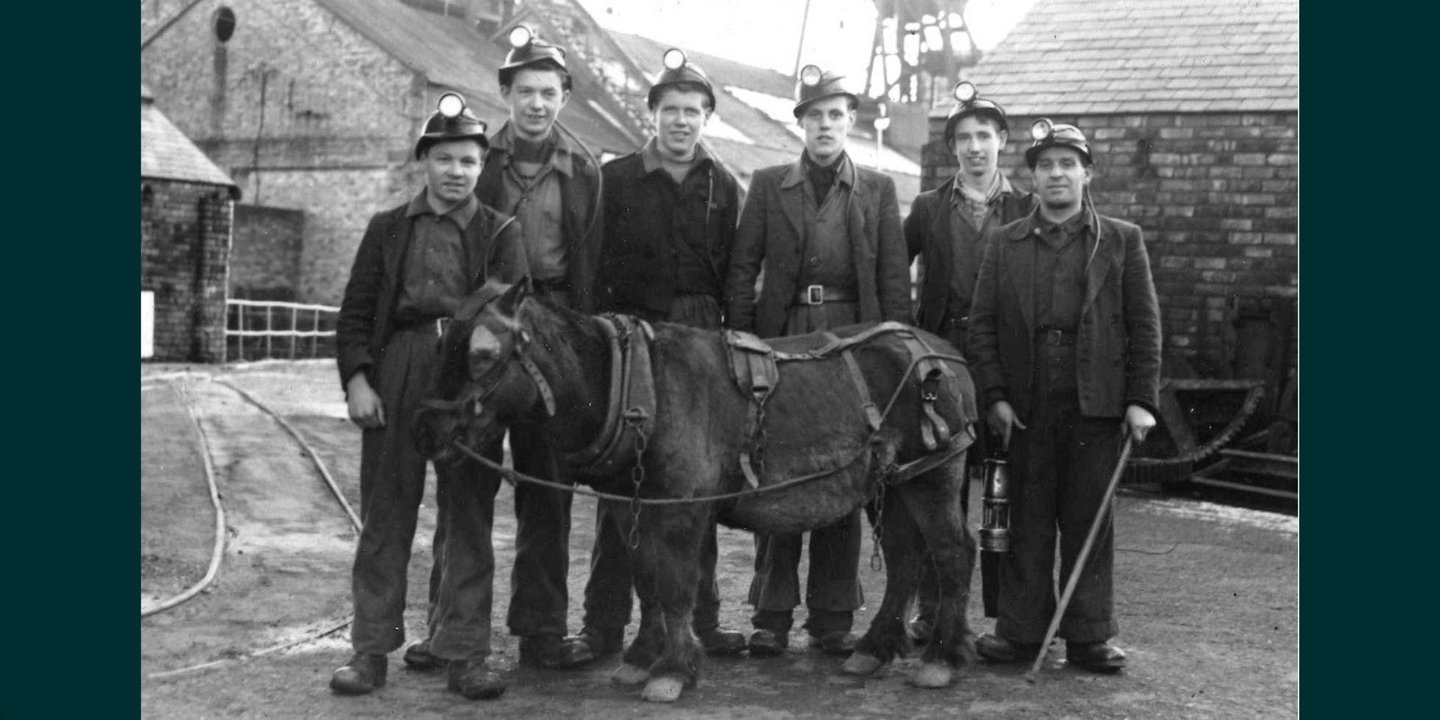
“From Coalmining to Data Mining” (Paul’s father is the fourth miner counting from the left).
The inception of NICD
It was clear that if we were to rise to the challenge then a new approach was needed. Over long discussions with Steve Caughey and Barry Hodgson in various locations (including the British Museum Cafe, Grasmere, and The Hotspur) we came up with an idea for a national centre with a radically new way of working with industry and wrote it up as a two-page proposal. We then socialised the idea to anyone who would listen — we had excellent feedback and support from Dynamo, Newcastle City Council, and of course Newcastle University.
Eventually, the idea reached the ear of the government, and we were delighted when funding for the Centre was announced in a George Osbourne budget. Being awarded £15M for a two-page proposal seemed too good to be true... and it was. When we read the written budget transcript, the award was annotated with an asterisk which we discovered stood for “Subject to an agreed business plan”. Securing agreement required a year of work during which Barry had to write a 100-page, treasury-format proposal that was reviewed at multiple meetings in Westminster with the Government’s Department for Business, Energy & Industrial Strategy (BEIS). At the time they were overwhelmed dealing with the consequences of the recent BREXIT vote, and so we were just an annoying distraction. Eventually, the process reached a successful conclusion and we were sent away from the final review with the words, “We enjoy talking with you, but we never want to see you again!”.
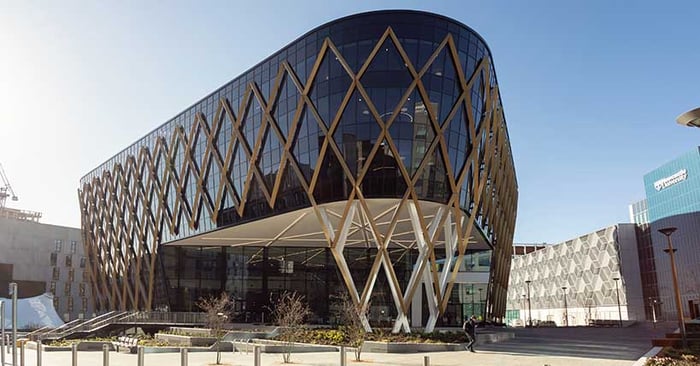
After that, our initial focus was on building both a team and The Catalyst (all the government investment was for the building, with Newcastle University funding the team). The National Innovation Centre for Ageing (NICA) had received funding for a new building a year before NICD, and the original plan was to build two new innovation buildings on the Helix Site. Over a long train ride to BT in Ipswich and back with Roy Sandbach, the first Director of NICA, we agreed that by pooling our funding we could create one iconic, new type of innovation building. Thanks to the architects GSS, the interior designers Design North, and Oxford Innovation, this became a reality in the iconic Catalyst.
The launch of NICD
NICD Launched in 2017 with Steve Caughey as the first Director, Barry Hodgson as Deputy, and myself as the Research Director. At the heart of NICD has always been our wonderful team of AI and data science experts, and the professional services staff who admirably support them. Over the past nine years, NICD has completed over 180 successful projects with organisations of all sizes and sectors, around half of them SMEs. Over this time, technology has moved on rapidly, but our team have demonstrated their ability to remain at the forefront. When we started, we mainly applied advanced statistics and machine learning to address business opportunities. But, over the past five years, AI has grown in importance, with Large Language Models being deployed in many of our projects.
One reason for the success and impact of NICD is that the team have innovated in the way projects are delivered. Most have been “Skills Transfer” projects. In these, the NICD team works collaboratively with staff from the client, transferring relevant AI and data science skills to them through the course of the project. The result is that, at the end of the project, the client does not just have a new data-driven service, or new insights that lead to better business decisions, they also have staff who have been upskilled in AI and data science and are able to identify and realise new opportunities themselves. This scales-up the benefits of working with NICD.
.png?length=1440&name=Paul%20Watson%20Farewell%20Blog%20images%20(1).png)
The NICD team at our Data Innovation Showcase event in September 2024
NICD's impact
An independent report by Ortus Economic Research Ltd in 2026 has captured the impact on the region and the whole of the UK, including both the direct impact from NICD projects, and that due to NICD playing a key role in attracting inward investment:
"NICD has delivered excellent value for money to the public purse"
-
generating £27.20 of net additional GVA for every £1 of direct public funding [≈ four times UKRI average
"NICD has made a significant and unique contribution to the UK and North East economies"
- supporting businesses in developing and implementing data science skills:
- 570 net jobs created across the UK of which 476 are in the North East, typically in highly skilled, well-paid roles
- £141M cumulative net additional net GVA to national economic output (est. £517M by 2036) of which £116M is in the North East (est. £424M by 2036).
- a unique regional asset which serves to attract inward and local investment:
- 1,584 new jobs created in the North East alone
"NICD is set to play a major role in delivering an economic benefit to the UK economy"
-
totalling £1.2BN in net additional GVA over the coming decade, of which £1.1BN will occur in the North East.
"It has played a key role in attracting over £102M of public research funding to Newcastle University"
"Impacts are beginning to scale considerably, as NICD’s reputation and reach grows".
Ortus Economic Research Ltd, 2026
NICD's relationship with Newcastle University
NICD has benefitted immensely from being hosted by Newcastle University. As well as providing us with access to academics who are world-leading AI experts, it has also generated a pipeline of talent that we have recruited to form the core of the team, augmented by others coming to us from industry and other universities to ensure a diversity of experience and thinking.
Over the past few years, we’ve also used what we’ve learnt from our work to help produce the next generation of industry-ready graduates. There is a concern in the government and industry that many of today’s AI graduates lack the skills to exploit AI and data science to address business needs – there’s a chasm between the graduates’ deep skills in AI methods, and the additional skills needed to realise business opportunities. Barry Hodgson has led on addressing this through Data Innovation Bootcamps and other modules that teach Newcastle students the methods NICD uses to bridge this chasm, using real case studies from our industry projects. We now have a file of emails send to us by students saying they were told that the main reason they were offered their job, against fierce competition, was because they were the only one interviewed who had these additional skills.
.png?length=1440&name=Paul%20Watson%20Farewell%20Blog%20images%20(6).png)
Image of the Catalyst on the front of a 2026 Newcastle calendar
The next chapter
At the end of September, I step down from NICD after a decade, leaving it in the capable hands of Barry Hodgson and our new Skills and Policy Director. I am delighted with the positive impact that the NICD team has had on the region and wider UK. It has also been rewarding to see The Catalyst become the iconic, innovation hub that we were aiming for (we knew The Catalyst had achieved iconic status when it was featured on the cover of the Newcastle 2026 Calendar!).
What's next for me? I’m excited to be returning to the School of Computing to focus on research projects harnessing AI to transform healthcare, something I’m passionate about. But I’m also looking forward to following the progress of the wonderful NICD team as it continues to grow its impact on the economy and society of the North East and the wider UK.
.png?length=1440&name=Paul%20Watson%20Farewell%20Blog%20images%20(5).png)
You can read more of our news stories and sign up to our newsletter to keep up to date with our latest news, events and developments.