
A new independent Economic Impact Report has revealed the scale of the National Innovation Centre for Data’s (NICD) contribution to jobs, skills, investment and economic growth, providing a proud moment to reflect on what has been achieved and look ahead to our next chapter.
On Wednesday 16 September 2026, we brought together partners, businesses and stakeholders at The Catalyst in Newcastle-upon-Tyne for a special Impact, Legacy and Future event, celebrating nine years of collaboration, innovation and growth, while looking ahead to the opportunities still to come.
At the heart of the event was the launch of our new independent Economic Impact Report, prepared by Ortus Economic Research Ltd. The findings put numbers against something that our team, partners and the organisations we work alongside see every day: the lasting difference that building data science and AI capability can make to businesses, people and the wider economy. And the numbers give us plenty to be proud of.
£141 million and counting
The independent assessment found that NICD has generated £141 million in cumulative net additional Gross Value Added (GVA) for the UK economy between 2018 and 2026, with £116 million retained in the North East.
Our collaborative work has directly supported the creation of 570 net additional jobs across the UK, including 467 in the North East, while up to 6,600 people working within client organisations have been upskilled through NICD’s portfolio of projects.
Since NICD was established, our team has delivered more than 180 collaborative projects, working with SMEs, major businesses and public sector organisations, including Sage, NHS England, Procter & Gamble and Newcastle Building Society.
The report also highlights the wider catalytic effect NICD has had on the North East economy. Its activities and presence in the region are associated with inward investment that has attracted an estimated 1,584 jobs, demonstrating the role that specialist data and AI capability can play in making the North East an attractive place for businesses to invest and grow.
Just as importantly, the report shows the value delivered from the investment made in NICD. For every £1 of direct public funding invested, £27.20 in net additional GVA has been generated, demonstrating the strength of NICD’s collaborative approach and the economic value of investing in data and AI capability.
For us, however, the figures are about much more than numbers on a page. Behind them are businesses that have grown, people who have developed new skills, organisations that have found better ways of working, new jobs and investment brought into our region, and teams that are now able to identify and pursue data and AI opportunities for themselves.
That lasting capability is fundamental to the NICD model.
Rather than simply delivering a technical solution and walking away, our experts work alongside teams to solve real organisational challenges while transferring their data science and AI knowledge. That means the skills stay within the organisation long after an individual project has finished, allowing the benefits to continue and multiply.

Image of Professor Paul Watson presenting at the National Innovation Centre for Data's, Impact, Legacy and Future event.
Celebrating impact, legacy and the future
The launch event provided an opportunity not only to reveal the results but also to hear about the real-world experiences behind them.
The morning brought together NICD's community to reflect on the Centre's contribution to regional and national economic growth and innovation, with a panel discussion designed to bring the economic findings to life through practical examples and first-hand experiences.
It was also a significant moment in NICD’s journey as we reflected on our leadership and looked towards the Centre’s next chapter. The event marked Professor Paul Watson stepping down as Director and included the formal introduction of NICD's new Policy and Skills Director, Ashmita Randhawa, creating an opportunity to consider how the Centre can build on the foundations established over its first nine years.
As Professor Paul Watson, Director of NICD, said in announcing the findings:
“This new economic analysis highlights the significant positive contribution that the National Innovation Centre for Data has made to both the North East and the wider UK through developing workforce skills, creating jobs and attracting inwards investment.”
He added that NICD's ambition is now to “build on this impact and help even more organisations realise the value of their data.”
A major contribution to the North East
While NICD works with organisations across the UK, it is particularly encouraging to see the scale of the impact being felt here in the North East.
As well as the £116 million in cumulative net additional GVA already generated in the region, the report forecasts that the vast majority of NICD's future economic impact will benefit the North East.
Taking NICD's collaborative activity and its role in attracting investment together, the report projects an economic benefit of £1.2 billion by the end of 2036, of which £1.1 billion is expected to occur in the North East.
NICD has also helped strengthen Newcastle University's wider research and innovation ambitions. Between 2018 and 2026, NICD supported and contributed to successful funding bids that have attracted more than £102 million of public research funding to the University.
That combination of business collaboration, skills development, academic expertise and investment attraction demonstrates the wider role NICD has come to play within the North East's data and AI ecosystem.
Proud of what we have achieved, excited about what comes next
When NICD was established, its purpose was clear: to bridge the gap between world-leading expertise in data science and AI and organisations that could benefit from those skills but did not necessarily have the capability to exploit their data themselves.
Nine years later, this independent assessment gives us the opportunity to step back and see just how far that mission has taken us.
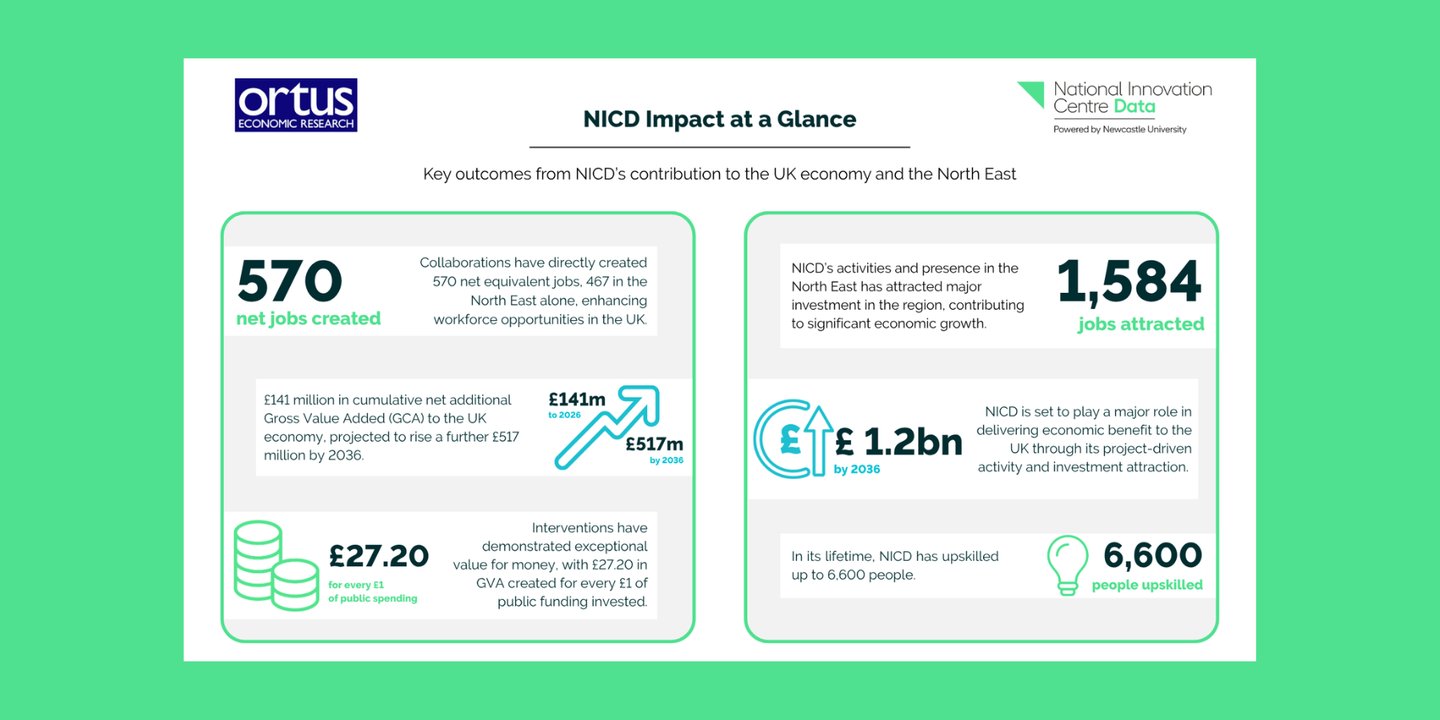
NICD impact overview infographic.
These results belong to everyone who has been part of the NICD journey: our team, Newcastle University, our funding partners and, crucially, every organisation and individual who has collaborated with us.
We are incredibly proud of what has been achieved so far. But this report is not an end point.
Data and AI are moving faster than ever, and the challenge of ensuring businesses and organisations have the skills, confidence and capability to take advantage of them has never been more important. As we enter our next chapter, our ambition is to build on the foundations of the last nine years and extend that impact even further.
Because if the first nine years have demonstrated anything, it is what can happen when expertise is shared, skills are embedded and innovation happens through genuine collaboration.
And we are only just getting started.

You can read more of our news stories and sign up to our newsletter to keep up to date with our latest news, events and developments.

.png?length=700&name=Paul%20Watson%20Farewell%20Blog%20images%20(3).png)