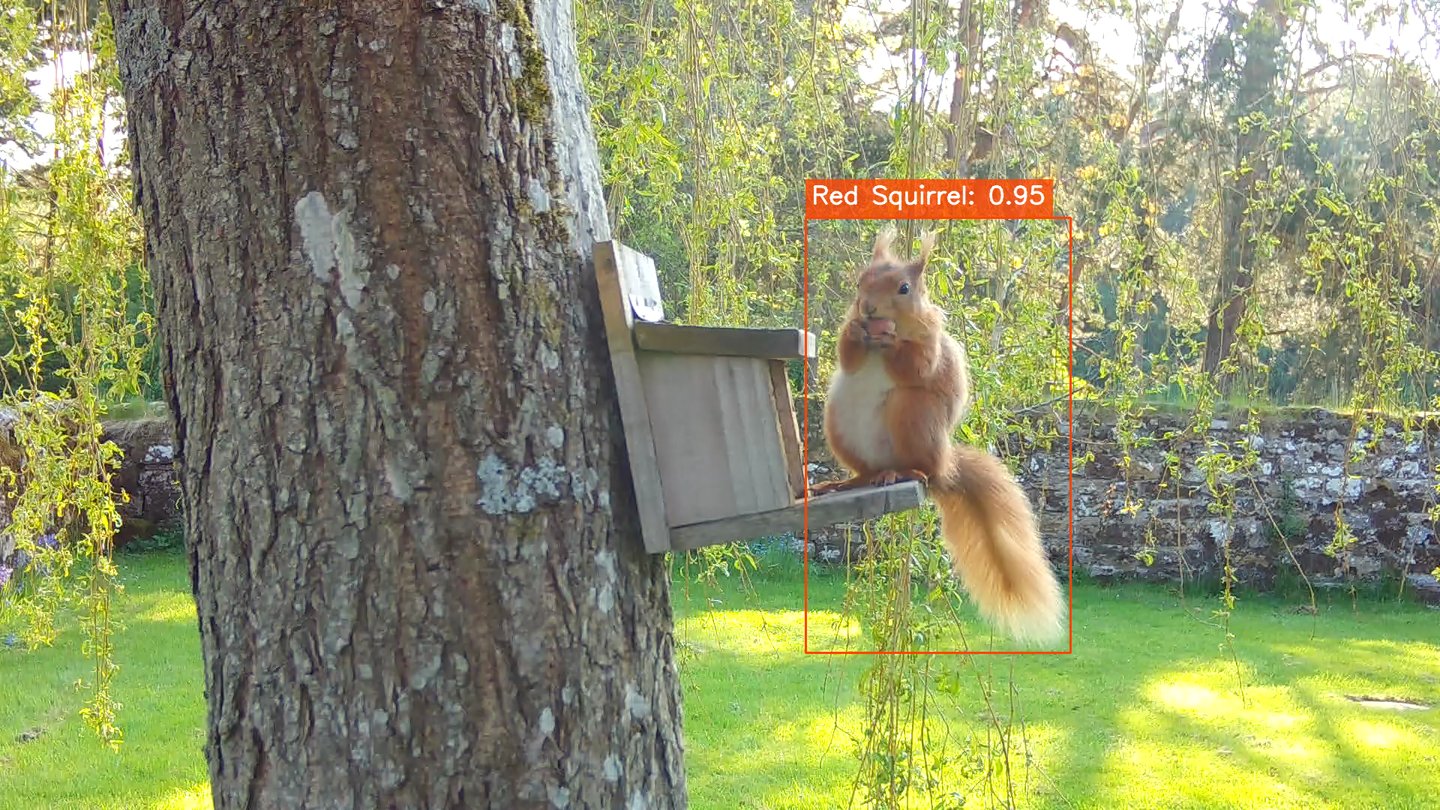
As part of a Department for Science, Innovation and Technology (DSIT) funded AI traineeship programme, the National Innovation Centre for Data (NICD) partnered early-career data scientists with organisations to tackle real-world challenges using data science and AI.
One of those organisations was E3 Design, whose project focused on a unique conservation challenge: exploring whether artificial intelligence could help support the protection of the UK’s endangered red squirrel population.
Through the collaboration, trainees gained hands-on experience developing and testing computer vision models in a live project environment, while E3 Design received a proof of concept demonstrating how AI could contribute to passive wildlife management strategies.
Applying AI to a conservation challenge
Grey squirrels are an invasive species in the UK and pose a significant threat to native red squirrels through competition for resources and the spread of disease. Existing population management approaches often rely on trapping and culling, which can be resource-intensive and difficult to sustain, particularly in volunteer-led conservation efforts.
Currently there is work being carried out in the UK to develop a contraceptive that can be given to grey squirrels. E3 Design wants to design an automated feeder system to aid with giving these contraceptives. The main obstacle is how to make sure only grey squirrels are deposited with the contraceptive. This becomes increasingly important in areas occupied by both red and grey squirrels.
The project explored whether a computer vision model could distinguish between red and grey squirrels in real-time video footage captured by trail cameras. The longer-term ambition was to integrate this capability into a smart feeder system that could automatically lock or unlock depending on which species was detected.
The intended application centred around the potential use of contraceptive-treated feed for grey squirrels. To ensure red squirrels would never access the feed, the system needed to accurately identify the species present before opening the feeder.
For trainees, the project offered an opportunity to work on a technically challenging problem while also contributing to a wider environmental goal.
Building a real-time detection model
The trainees worked with thousands of images generated from trail camera footage supplied by E3 Design. Video files were first split into individual frames before being prepared for model training.
The first task the trainees faced was to create a high-quality training dataset. Videos were labelled based on which species was present within them, however more-fine grained annotations were needed to be able to detect where the red and grey squirrels were within the video footage. To create a high-quality training dataset, the team explored using object detection techniques to identify squirrels within the images and generate bounding boxes around them. The predictions were then manually reviewed, updated and refined using LabelStudio to ensure the annotations were accurate.
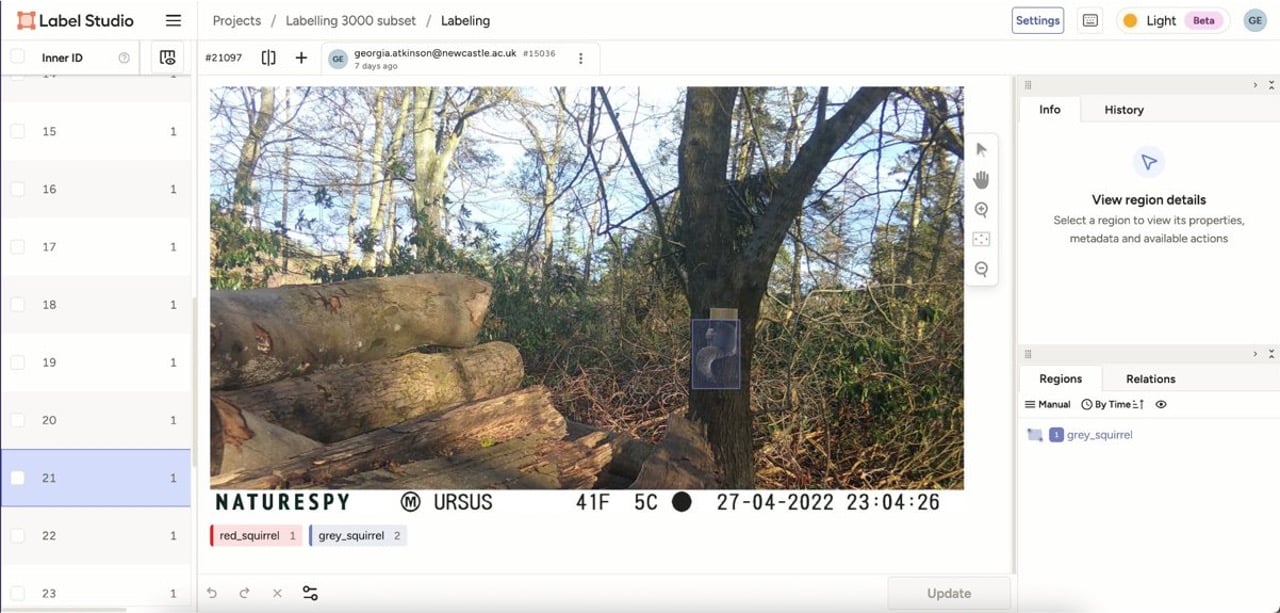
Screenshot showing the Label Studio interface labelling an image of a grey squirrel. Original image owned by Ian Glendenning.
To create high-quality training data, the trainees first explored several general-purpose object detection models, as well as labelling tools to view, update, add or remove annotations from images produced by the object detection models. Initial experiments using with these models produced limited results as they did not have the concept of an animal or were trained on only specific species (e.g. dogs, cats, etc.).
To overcome this, the team adopted MegaDetector, a wildlife-focused object detection model designed specifically for trail camera imagery which can detect classes ‘animal’, ‘person’ and ‘vehicle’. This significantly improved the detections of squirrels within the images, however manual refinement was still needed, and allowed the trainees to build a more robust labelled dataset.
_Dueshill-Wood_000240%201.png?length=700&name=bottom%20(6)_Dueshill-Wood_000240%201.png)
_Quarry_000000%201.png?length=700&name=quarry_02%20(8)_Quarry_000000%201.png)
Example outputs from MegaDector showing bounding boxes and labels. Original images owned by Ian Glendenning.
The team then experimented with fine-tuning multiple object detection architectures, including EfficientDet, D-FINE, RT-DETR and RF-DETR to create an object detection model capable of detecting red and grey squirrels within trail-camera footage. Following evaluation and testing, RF-DETR was selected as the final model due to its stronger overall performance.
The resulting model could detect both red and grey squirrels within video frames and classifying them separately.
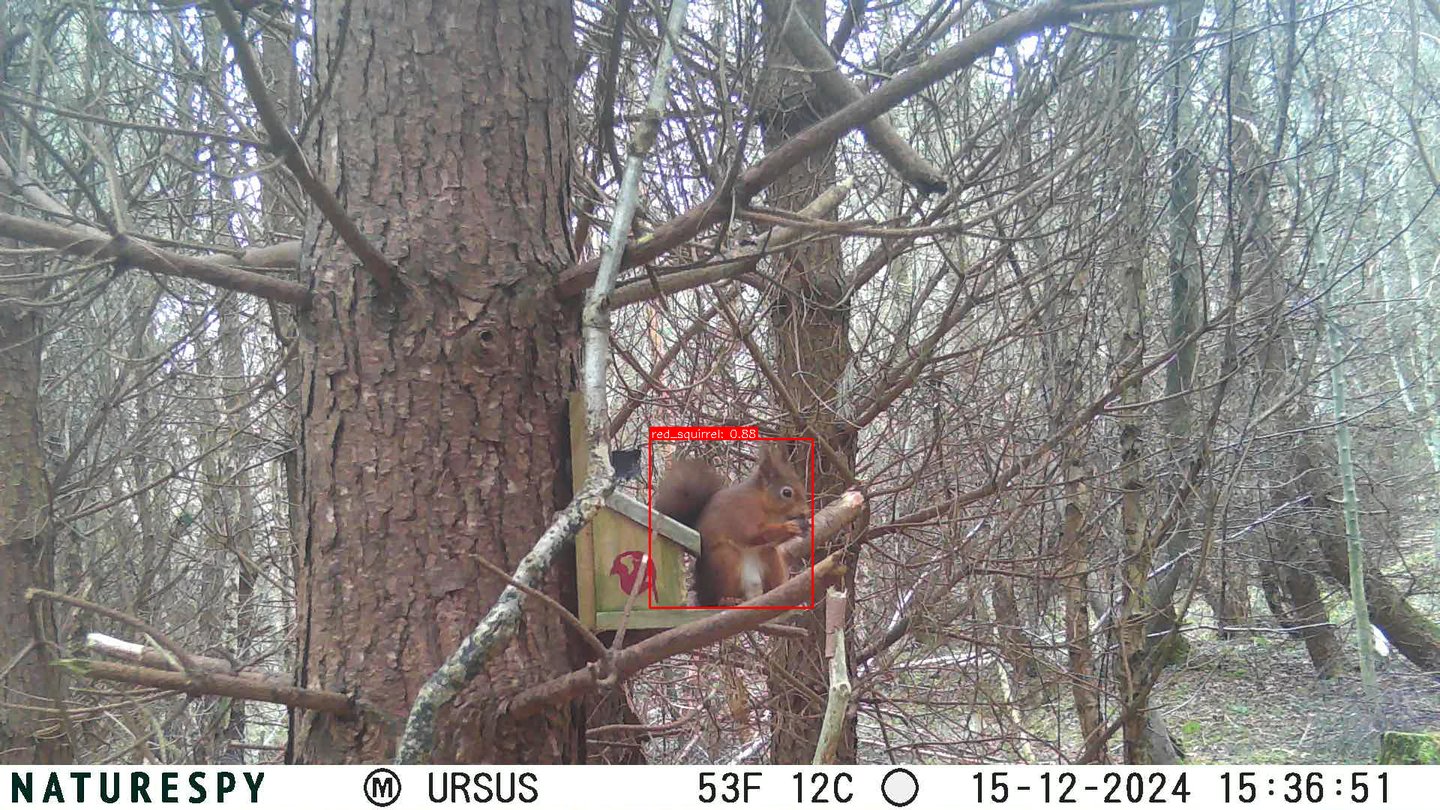
Example RF-DETR output labelling a red squirrel. Original image owned by Ian Glendenning
Translating detections into feeder decisions
Alongside the computer vision model itself, the trainees also developed logic to determine how the feeder should respond based on recent detections.
The system analysed a rolling sequence of recent video frames and used this information to decide whether the feeder should remain locked or unlocked.
If a red squirrel was detected at any point within the recent frame sequence, the feeder remained locked. If only grey squirrels were detected, the feeder unlocked. In cases where no squirrels were detected, the feeder defaulted to a locked state as an additional safety measure.
This conservative approach was designed to minimise the risk of red squirrels accidentally gaining access to feed intended solely for grey squirrel population control.
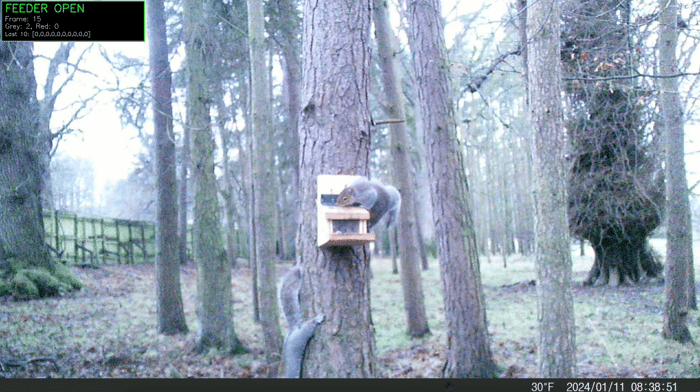
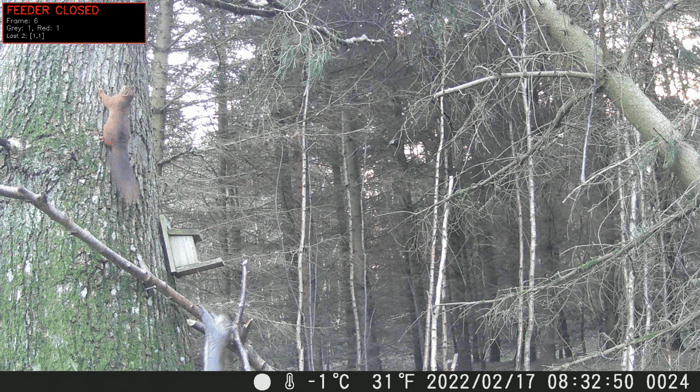
Simulated examples of the feeder logic implementation. This uses the output from RF-DETR to determine when the feeder should be opened or closed. Original images owned by Ian Glendenning.
Learning through experimentation and deployment challenges
The trainees investigated several approaches to machine learning deployment and optimisation, including ONNX model conversion, quantisation techniques, and the use of ExecuTorch for edge deployment.
Although no deployment solution was implemented, the work helped the team develop an understanding of the tools, processes, and challenges associated with deploying machine learning models in practice.
Delivering a strong proof of concept
The final model exceeded the client’s original target of 50% accuracy, achieving more than 80% accuracy on the project test dataset.
While further training and optimisation would still be required before any operational deployment, the project demonstrated that real-time AI-driven squirrel detection is technically achievable.
The work completed during the traineeship now provides a strong proof of concept that E3 Design can continue to build upon as the project develops further.
The collaboration also laid important groundwork for future innovation activity, helping demonstrate the potential for data-driven approaches within wildlife conservation.
Developing practical AI experience
For the trainees involved, the project provided experience working within the realities of a live industry collaboration.
Alongside technical development, trainees regularly met with E3 Design throughout the project, presented updates, discussed challenges and adapted their work in response to feedback and evolving project requirements.
The collaboration also included a field visit to better understand the environmental and operational context behind the challenge, helping connect technical work to real-world conservation needs.
“We went on a field trip and met the stakeholders involved,” said Harish, AI Trainee, “It’s not just a technical exercise. Meeting the people who’ll use our solution makes it feel like the project has life to it.”
For many trainees, the project provided an opportunity to move beyond academic exercises and apply their skills within a meaningful real-world setting.
Lucy, AI Trainee reflected on the difference between university study and industry collaboration:
“Getting to work on real problems, as opposed to the lab-based work we did at university, has been really fulfilling. It’s satisfying to see how what we’re doing will actually be used.”
The traineeship also allowed participants to shape projects around their interests and career ambitions.
“You’re able to work on AI projects aligned with your interests and what you want to do in the future,” said Saxen, AI Trainee. “We’re paired with mentors who have similar interests, like my mentor who is also in the conservation space.”
The experience also encouraged trainees to continue building confidence in unfamiliar technical areas.
“I’ve been learning technical skills outside of my comfort zone, so I’m looking forward to seeing how the next projects will help me upskill even further,” added Lucy.
By contributing to a project with clear practical and environmental impact, trainees gained valuable experience applying AI techniques beyond academic exercises while developing confidence in stakeholder communication, experimentation and problem solving.
Looking ahead
The E3 Design collaboration highlights how AI and computer vision technologies could support innovative approaches to wildlife conservation challenges.
While additional rigours testing would be required before deployment in real-world settings, the project successfully demonstrated the potential for machine learning to support species identification and automated decision-making in conservation applications.
For NICD trainees, the project provided an opportunity to develop technical and professional skills through meaningful industry experience.
Project lead and NICD Senior Data Scientist, Georgia, says, “It was great to be part of this project and help guide the trainees to deliver a successful project with a meaningful application. The project is close to my AI for conversation background, so it was great to help the trainees through the process and watch them learn and enjoy working in this space.”
For E3 Design, it delivered a valuable foundation for future work exploring passive grey squirrel population management strategies and the wider role AI could play in conservation-focused innovation.
To hear about the experience from the trainee’s themselves, watch this video.
You can read more of our news stories and sign up to our newsletter to keep up to date with our latest news, events and developments.